The first GPS satellite with L5 signal( the IIR(M)-20 ) was successfully launched on March 24, 2009 and its L5 payload activated on April 10, 2009. This is a significant milestone in the GPS modernization efforts.
We are proud to announce that all of our customers with our "triple-frequency" type OEM boards( TR-G2T, TR-G3T, TRE-G2T, TRE-G3T, TRE-G3TAJ) and receivers (TRIUMPH-1, Alpha TR-G2T/TR-G3T, DeltaS TRE-G2T/TRE-G3T/TRE-G3TAJ, SigmaS TRE-G2T/TRE-G3T/TRE-G3TAJ) can now track this signal.
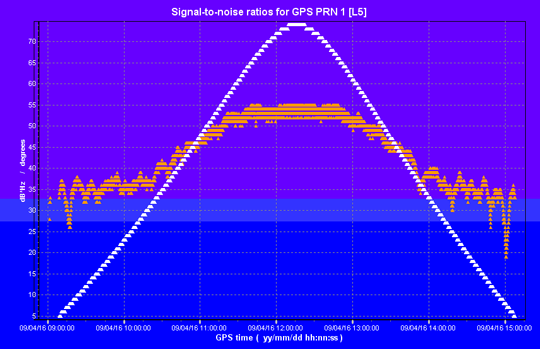
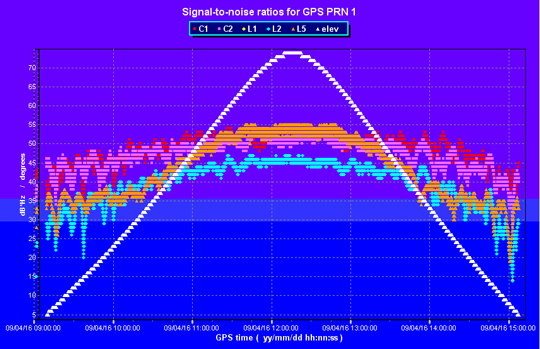
The signal characteristics clearly indicate that our receivers allow high quality code and carrier phase measurements of the L5 signal. The signal-to-noise ratio typically varies from about 30 dB*Hz at low elevations up to 57 dB*Hz at zenith( see the figure below ).
The white-noise, multipath, etc tracking errors are comparable to what we normally have for the L1 and L2 signals.
Those interested in sample raw data with the "triple-frequency"(L1-L2-L5) code and carrier phase measurements from IIR(M)-20, can download some from "GNSS Almanac Archive"( see the ADVANCED section on www.javad.com). Note that these sample raw data are available in the JAVAD GNSS proprietary binary format as well as Rinex 3.0.